
2026-01-06 / News
[kokosil Case Study | Kamiamakusa City Interview] Digital Vouchers to Counter Rising Prices Help Bridge Residents' Digital Divide
Ubiquitous Computing Technology Corporation offers kokosil, a digital platform providing a wide range of local information services to tourists, including visitors from overseas, and local residents.
The platform includes a broad selection of features to meet different needs: guides to tourist attractions and stores, news and event information, stamp rallies that encourage people to explore an area, and tourism passports offering benefits and coupons at facilities and stores. A key advantage is that it can be customized into an original tourism app, town-walking app, comprehensive municipal app or museum exhibit guide app at low cost and in a short time. It has now been introduced in approximately 90 regions across Japan.
kokosil also offers kokosil Regional Points, a feature designed to revitalize local economies by allowing users to buy goods and services at a discount with points purchased in advance through credit card or convenience-store payments. Kamiamakusa City in Kumamoto Prefecture has used this feature for three years since fiscal 2023 to run a premium digital voucher program on kokosil Kamiamakusa. By adding a bonus to the amount purchased, the program aims to support residents and local businesses affected by rising prices, while also promoting digital and cashless payments.
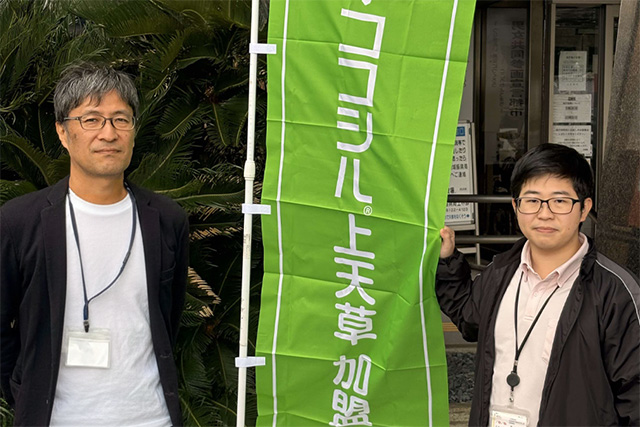
We spoke with Hiroyuki Yamada, head of the Industry Promotion Section, and Nagi Kusumoto of the Tourism and Hospitality Division, Economic Promotion Department, Kamiamakusa City, about the background to introducing kokosil and the response from businesses and residents.
Interviewer: Could you tell us what led Kamiamakusa City to launch the premium digital voucher program? We understand that you both took charge of the program in fiscal 2024, so please share what you know.
Yamada:
Two factors were behind it: the national government was encouraging municipalities to pursue digital transformation, and the local economy had been hit hard by COVID-19, creating a need for swift recovery measures. I understand that these two factors led to a decision that we should introduce some kind of economic support measure using digital technology.
Conventional paper vouchers were apparently considered too, but the time and cost involved in printing and delivery were challenges. Paper vouchers also require in-person work for sorting and checking quantities. Social distancing was a priority at the time, and there was a need to minimize crowding, which seems to have contributed to the choice of digital vouchers.
Kusumoto:
We had actually run a paper voucher program before, but rather than mailing them out, city employees and chamber of commerce staff set up sales tents outdoors and sold them in person. Residents had to come to collect them, and wearing masks in the midsummer heat seems to have posed a significant risk of heatstroke. I think considerations like those also helped prompt the move toward digitalization.
Interviewer: Following a competitive proposal process for a digital voucher system, you selected our kokosil platform. Could you tell us, as far as you are able, why it was chosen?
Kusumoto:
Our city was already running a health points program. Residents could earn points for activities such as health checkups or using the municipal gym, then redeem a certain number of points for a JPY 500 voucher. Our digital transformation policy had the ultimate goal of bringing that points program and the proposed digital voucher program together in one all-purpose, comprehensive app. kokosil was originally developed as a tourism app to encourage visitors to explore an area, and its high level of extensibility seems to have been the deciding factor. If we had only needed digital vouchers, another service specializing in electronic payments might have been selected.
Kamiamakusa is also a tourism destination, so I think another positive factor was how well kokosil's location-based services fit our tourism initiatives.
Interviewer: How did it compare in terms of cost?
Yamada:
I do not know the full details of other providers' services, but I understand that kokosil had an overwhelming cost advantage, partly because it is an app shared by various regional organizations. The difference may even have been an order of magnitude... [laughs].
Interviewer: Really! We are curious about other companies' costs too, but we did not realize the advantage was that large. That is a surprise.
In the first year, 2023, you sold vouchers limited to restaurants under the name Kamiamakusa Digital Dining Vouchers. Could you explain specifically how the program worked?
Kusumoto:
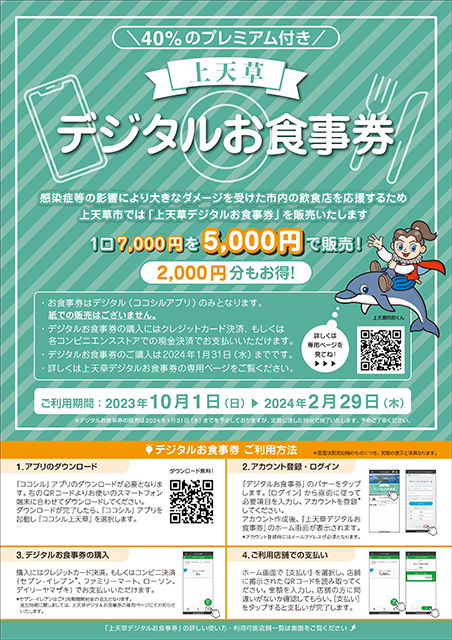
As this was our first voucher program involving digitalization, we initially limited it to around 30 restaurants and sold dining vouchers to keep administration from becoming too complicated. The vouchers offered an unusually generous premium: a JPY 5,000 purchase provided JPY 7,000 in spending power, a 40% bonus. It was a bold rate that would be hard to imagine now, but restricting use to restaurants had more of an impact than we expected. We received many comments from residents saying they wanted to use the vouchers for everyday shopping, such as clothing and groceries, and my impression is that usage did not spread very widely.
Yamada:
I also think a major issue was that we had not clearly identified our target audience. Were we trying to reach tourists or residents? We tried to include both, without communicating a clear message to either. Even if tourists were told about the app on arrival, registering and using it on the spot was a hurdle. Meanwhile, eating out regularly was not part of the local culture, so residents had limited opportunities to use the vouchers. I feel there was a mismatch there.
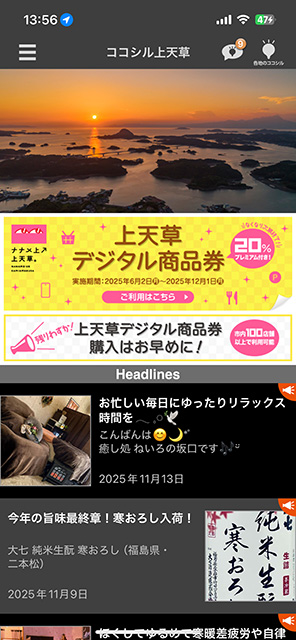
Interviewer: In response to feedback like that, in fiscal 2024 the program became Kamiamakusa Shopping Points, aimed at city residents and usable at retailers, accommodation facilities and other businesses. It ran from September 2, 2024, to February 28, 2025. In fiscal 2025, it was renamed Kamiamakusa Digital Vouchers and expanded further, running from June 2 to December 1, 2025. What results and responses have you seen over these three years?
Yamada:
The name has changed every year, from Digital Dining Vouchers in fiscal 2023 to Kamiamakusa Shopping Points in fiscal 2024 and Kamiamakusa Digital Vouchers this fiscal year. But residents and businesses now simply know it as kokosil. People ask us, 'Will you be doing kokosil again this year?' I think that level of recognition is a major achievement. There were fewer than 30 participating stores in fiscal 2023. When we expanded eligibility to general retailers in fiscal 2024, that grew to around 70, and this fiscal year it has reached 105.
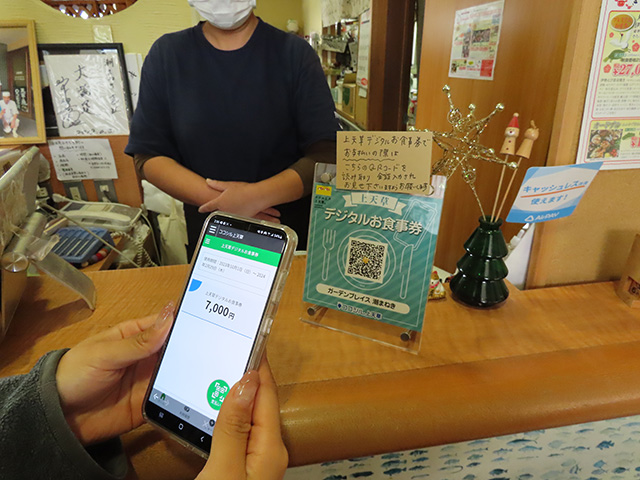
Another major change is that businesses understand the program better. More of them now carefully explain everything to users, from installing the app and registering an account to adding funds. Businesses with higher-priced purchases in particular seem to actively encourage customers to use kokosil, telling them they can save money. Businesses also asked for a visible way to show that they accept digital vouchers, so in fiscal 2024 the Digital Points Executive Committee, which runs the program, created banners identifying kokosil Kamiamakusa participating stores. Seeing those banners displayed at stores also makes us feel that attitudes toward the program have changed.
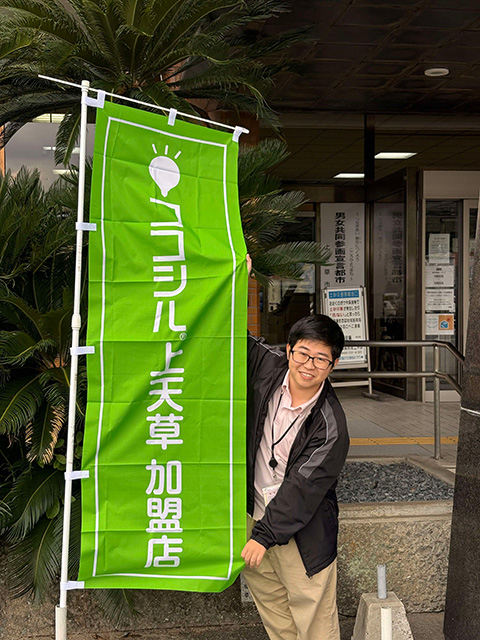
Interviewer: When the Kamiamakusa Digital Dining Vouchers program launched in 2023, we visited local businesses to explain how to use kokosil. I remember many people saying they were not very familiar with smartphones or did not know how to download an app. Do you feel that those businesses have become less resistant to digital technology over these three years?
Yamada:
Yes. They probably get questions from users too, and I feel that more businesses now have a positive awareness that they need to be able to handle this properly or risk losing business opportunities, compared with 2023.
Interviewer: We are very pleased that the program is also helping bridge the digital divide in Kamiamakusa City. We would welcome your thoughts on any other benefits you have noticed from using and operating kokosil.
Yamada:
There are certainly budget benefits, but an even bigger advantage is your support system. The team's attention to detail and speed of response have been extremely helpful. The reassurance that we can entrust the work to this team is, I think, the main reason we want to continue the program with you each year. Residents are also getting used to kokosil, and businesses hardly need to be shown how to use it again. They can reuse what they registered the previous year, so there is little extra work and they can continue participating smoothly. That is another major benefit.
Interviewer: Conversely, are there any issues you see with the program or kokosil?
Yamada:
For the program itself, the first issue is our support arrangements. Ideally, we would be able to answer telephone inquiries about how to use it immediately, or provide support around the clock, but we were not able to put those arrangements in place.
As for kokosil, as Kusumoto explained earlier, we chose it with the intention of eventually developing it into a comprehensive app, or so-called super app. There were not many such apps available at the time, but now there are more app services that package multiple features together. Compared with those services, kokosil offers extensibility, but I do not recall being given a clear roadmap showing which features would be implemented, in what order and how. It feels as though we have stopped at the stage of saying that something could be built if we wanted it. We would like you to propose a clearer direction for developing a comprehensive app. It is also difficult for us to see at present how competitive kokosil is in terms of development costs and barriers to adoption compared with other companies' services, so proposals addressing those points would be very welcome. Sorry if that sounds demanding... [laughs].
Developing a comprehensive app will also require coordination with many different departments. There will be areas where it is difficult for us alone to persuade people and coordinate the work, so it would help if your company could provide more specific consulting support and advice.
Interviewer: Thank you for that valuable feedback. Finally, if you continue the program next year and beyond, how would you like to develop it?
Yamada:
In the longer term, we would like to operate it as an ongoing service, rather than as a time-limited event. Specifically, I think we need an operating organization independent of the local government and chamber of commerce, with a structure that can secure its own budget and sustain itself. If we can make it something users can continue to hold and use, like ordinary electronic money, I believe the value of the service and system could become incomparably greater than that of our programs so far.
Interviewer: Do you also have any plans for kokosil Kamiamakusa?
Yamada:
I am repeating myself, but we would like it to develop beyond economic support and tourism measures into a system that brings together and manages various points schemes positioned as local currencies, including the health points I mentioned earlier. However, approaches to local currencies vary from municipality to municipality, and not all examples have been successful. We see this as an issue that needs careful consideration across the entire city government, not just within the Tourism and Hospitality Division, to determine the best approach.
This fiscal year, we also set up a working group with your company's participation to examine uses across city departments. However, its activities are temporarily on hold because of the heavy rain disaster in August. Even so, the view that kokosil would be a good choice for handling points is gaining ground both within the city government and across the city. We hope to map out concrete ways to use it in the future.
Interviewer: When we heard that the working group had been put on hold because of the heavy rains, we were also unsure whether reaching out might place an additional burden on you. Going forward, we will actively make proposals with a comprehensive app in mind, in line with Kamiamakusa City's direction. We look forward to continuing our work with you on kokosil. Thank you very much for sharing your valuable time today.