
A Project Expected to Take a Month Was Completed in Nine Days
Running an RTOS on both cores of a dual-core MCU and coordinating them to control a robot arm over a network.
Anyone with embedded software development experience will recognize that this is far from a straightforward program. Even a basic working demo requires porting the RTOS and protocol stack, defining an inter-core communication protocol and debugging it. Without prior experience, this scale of development would typically take more than a month.
For this experiment, we deliberately assigned the project to a young engineer with just six months of RTOS experience. We also introduced one experimental rule: unrestricted use of AI for coding.
The result? In just nine days, the program was ready for an exhibition demo.
This firsthand account of multicore development with the μT-Kernel 3.0 RTOS shares a practical view of the remarkable speed generative AI can bring to embedded development—and the challenges specific to embedded systems that it exposes.
The development described in this article took place in May 2026. Generative AI is advancing rapidly, so the situation continues to change.
Development Target: Dual-Core Robot Arm Control with μT-Kernel 3.0
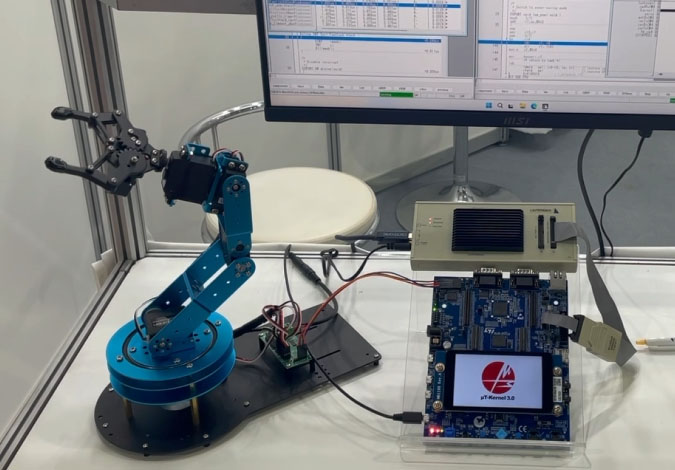
We built a demo system combining an STM32H747I-EVAL board with a six-axis robot arm.
The robot arm is controlled from a web browser on a PC.
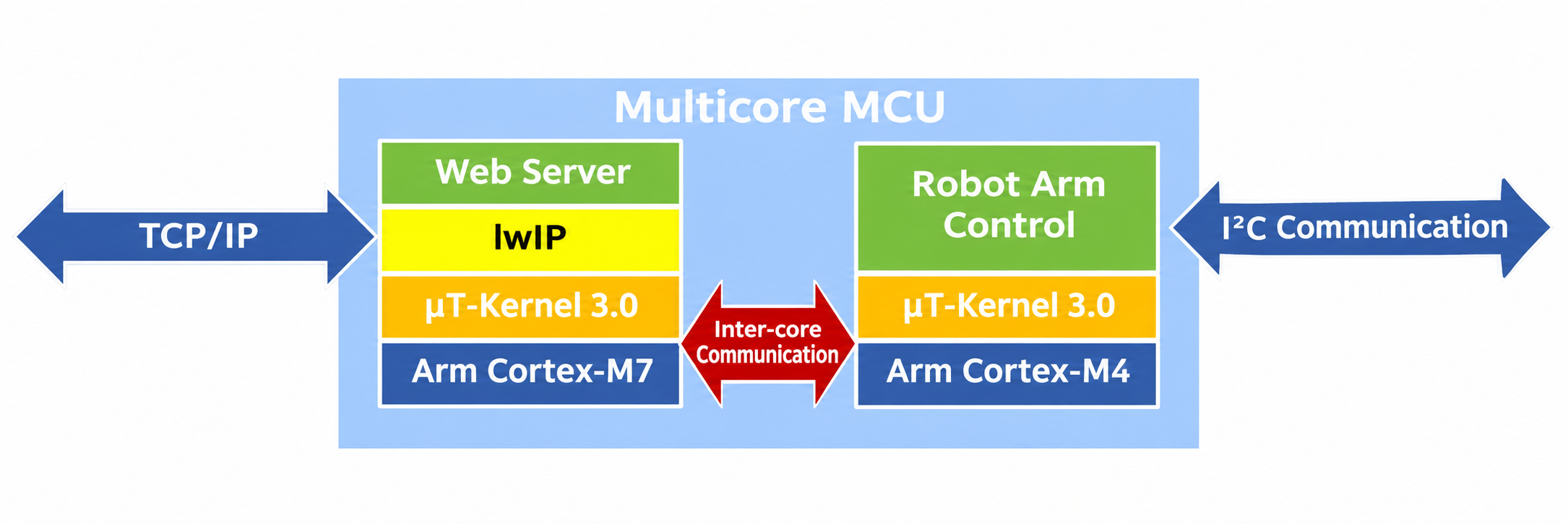
The responsibilities of each CPU core and the way they work together are as follows.
- Cortex-M7 (Core 0: High-Level Control)
- μT-Kernel 3.0 RTOS + lwIP (TCP/IP protocol stack)
- Acts as a web server that receives control requests from a PC browser through a REST API
- Cortex-M4 (Core 1: Actuation)
- μT-Kernel 3.0 RTOS
- Precisely drives the six-axis servos by controlling a PCA9685 PWM driver over I2C
- Inter-Core Coordination
- Shared memory, hardware semaphores and interrupt notifications
- Shared memory, hardware semaphores and interrupt notifications
When a PC sends a command over the network, Core 0 receives it and passes it to Core 1 through inter-core communication. Core 1 then moves the robot arm as instructed.
Why Did It Take Only Nine Days? A Development Timeline Built Around AI
Generative AI was used extensively throughout the project. During the design phase, we applied our expertise in porting μT-Kernel 3.0 and lwIP. All coding was performed by AI.
The development effort broke down as follows.
| Days | Work |
|---|---|
| 4 days | Porting μT-Kernel 3.0 and lwIP |
| 3 days | Implementing shared-memory control and interrupt-based inter-core communication |
| 2 days | Implementing application functions, including robot arm control logic and web API integration |
Because the project finished well ahead of the original estimate, we used the remaining time to add an LCD slideshow and an automatic demo mode that plays back predefined motion sequences.
Compared with writing drivers manually while consulting RTOS API references, AI offers a remarkable increase in the speed of initial implementation.
Pitfalls of AI-Assisted Embedded Development Revealed by Code Review
Can AI enable an inexperienced engineer to produce flawless embedded software? The answer is partly yes and partly no.
Although the demo worked, reviewing the completed source code revealed several problems that could not be overlooked in an embedded system.
1. Inter-Task Control That Ignores RTOS Fundamentals
We found basic antipatterns such as managing flags through global variables in situations that called for RTOS synchronization and communication mechanisms—event flags, semaphores or mailboxes—to provide mutual exclusion and synchronization between tasks. Code like this may appear to work when the timing happens to be favorable, but it can produce race conditions under heavy load or unexpected interrupts.
2. Excessive Debugging Routines Left in the Code
Unnecessary logging and state-checking code remained throughout the implementation. These traces suggested that AI had added excessive diagnostic code through trial and error as it tried to infer runtime behavior under the RTOS, including task preemption and dispatching.
Why Did These Problems Arise? Three Challenges Specific to Embedded Development
Rather than simply reflecting flaws in AI tools, these problems stem from the particular constraints of embedded development and the difficulty of giving effective prompts.
- AI Was Not Given the Right Context
A request as simple as “I want these two tasks to exchange data” may lead AI to propose a short route, such as global variables, that is common in web or general-purpose applications. Developers need the skills to provide prompts grounded in RTOS design principles—for example, “Use μT-Kernel 3.0 event flags for task synchronization and mutexes for mutual exclusion.” - Limited Training Data for Embedded Systems
Compared with common web frameworks or Python, far less high-quality code for RTOSs and MCU-specific peripheral control is publicly available online. As a result, AI may not always select embedded best practices on its own. - The Physical Barrier: AI Cannot Directly Debug the Hardware
In web development, it is relatively easy to let AI run tests, read error logs and repeat a debugging loop. Embedded development involves physical hardware problems: no waveform at a device pin, no I2C acknowledgment, or a core stopping while holding shared memory. These situations still require human intervention and an on-target debugger.
Why Fundamentals and Debugging Tools Matter in the AI Era
The main lesson from this experiment is that AI can be an extremely fast coder, but steering the design and assuring quality still depend on an engineer’s understanding of RTOSs and debugging skills.
Engineers who can give AI effective instructions, identify risks in generated code and use real hardware to expose and isolate multicore timing bugs can reduce development time to a fraction of what it was previously.
UCT’s Approach
We are actively working on the use of AI in embedded systems.
- Sound architecture design for embedded systems using RTOSs
- Standardized development processes combining prompt engineering with embedded domain expertise
- Advanced on-target debugging and verification solutions using multicore and JTAG debuggers
Please contact us if you want to adopt multicore MCUs or an RTOS but need a clearer path for design and debugging, or if you want to accelerate embedded development with the latest AI techniques.